 Beastie
How many push-ups can the average person do?
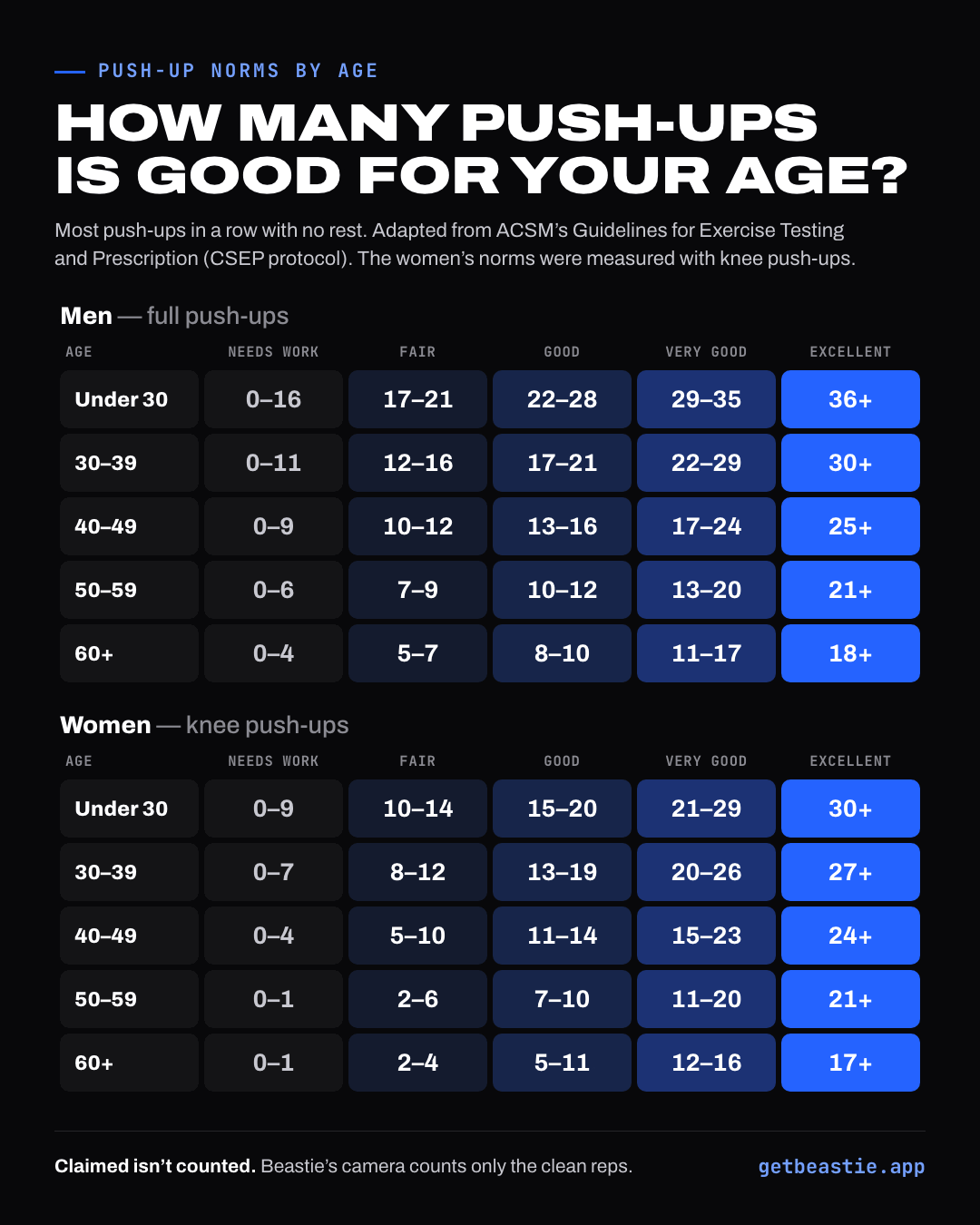
Going by the fitness assessment norms used in ACSM's exercise testing guidelines, a man under 30 doing 17–21 full push-ups is "fair" and 22–28 is "good"; by the 40s the good band starts at 13. Women's published norms use the knee push-up protocol: 15–20 is good under 30. The full tables are below — or answer three questions and get your rank straight away.
You’ve been called out
A friend claims push-ups (). How many have you got?
How old are you?
Which benchmark table?
The published norms are split this way — the women’s table was measured with modified knee push-ups. Pick whichever matches how you test.
How many can you do in one go?
Consecutive, no resting at the top for a minute. Be honest — the next screen is only as real as this number.

Contender
You said 0 — good for your age group



your phone
Free on iPhone and Android · counting happens on your phone · video is never uploaded
Push-up norms by age
Both tables are adapted from the push-up assessment norms in ACSM’s Guidelines for Exercise Testing and Prescription (the CSEP protocol): maximum consecutive push-ups, no rest, sampled from the general adult population — not gym-goers, not athletes. Men are measured with full push-ups, women with the modified knee push-up.
| Age | Needs work | Fair | Good | Very good | Excellent |
|---|---|---|---|---|---|
| Under 30 | 0–16 | 17–21 | 22–28 | 29–35 | 36+ |
| 30–39 | 0–11 | 12–16 | 17–21 | 22–29 | 30+ |
| 40–49 | 0–9 | 10–12 | 13–16 | 17–24 | 25+ |
| 50–59 | 0–6 | 7–9 | 10–12 | 13–20 | 21+ |
| 60+ | 0–4 | 5–7 | 8–10 | 11–17 | 18+ |
| Age | Needs work | Fair | Good | Very good | Excellent |
|---|---|---|---|---|---|
| Under 30 | 0–9 | 10–14 | 15–20 | 21–29 | 30+ |
| 30–39 | 0–7 | 8–12 | 13–19 | 20–26 | 27+ |
| 40–49 | 0–4 | 5–10 | 11–14 | 15–23 | 24+ |
| 50–59 | 0–1 | 2–6 | 7–10 | 11–20 | 21+ |
| 60+ | 0–1 | 2–4 | 5–11 | 12–16 | 17+ |
Two honest caveats. The bands describe the general population, so if you train at all you should expect to sit high in them. And every number in these tables was counted by a person with a clipboard — which brings us to the part where the numbers usually shrink: depth. A rep that doesn’t reach it isn’t a rep, and a camera that checks is stricter than a friend who counts.
The fine print on the numbers
How many push-ups should I be able to do?
It depends on your age and sex. In the published fitness bands, a man under 30 reaches the middle “good” band at 22 full push-ups; a man in his 40s reaches it at 13. Women’s published norms use the modified knee push-up protocol: under 30, the “good” band starts at 15. The full tables by age are on this page.
Do knee push-ups count?
In the published norms, yes — the standard assessment protocol measures women with the modified knee push-up, and those are the numbers in the women’s table here. In Beastie the counter is built for full push-ups: chest to depth, hips in line, elbows locked out at the top.
What counts as one push-up?
Full depth and full lockout: chest lowered until the elbows pass roughly 90 degrees, hips held in a straight line from shoulders to ankles, then pressed back to straight arms. A bounce that never reaches depth is not a push-up — which is exactly the line Beastie’s camera draws.
Where do these averages come from?
The bands are adapted from the push-up assessment norms published in ACSM’s Guidelines for Exercise Testing and Prescription (the CSEP protocol): maximum consecutive push-ups without resting, sampled from the general adult population rather than athletes.
What is the ACSM push-up test?
A standard fitness assessment: as many consecutive push-ups as you can manage without resting, with no time limit, scored against bands for your age and sex. It is published in ACSM’s Guidelines for Exercise Testing and Prescription following the CSEP protocol, and it is where every number on this page comes from. Men are tested in the full position and women in the modified knee position, which is why the two tables here differ.
What percentage of the population can do 20 push-ups?
Nobody can honestly give you a percentage, and the calculators that do are estimating. The published protocol sorts people into five bands — needs improvement, fair, good, very good, excellent — it does not report percentiles. What it does say is where 20 lands: a man under 30 doing 20 full push-ups is in the “fair” band, the second of five, and a man in his 40s is in “very good”. The band is the real answer. A precise percentage would be an invented one.
How many knee push-ups equal one full push-up?
There is no published conversion, and any tidy ratio you are offered is an extrapolation. What has actually been measured is the load: on a force plate, Ebben and colleagues (Journal of Strength and Conditioning Research, 2011) found a standard push-up puts about 64% of body weight through the hands and a knee push-up about 49%, in 23 recreationally fit adults.
That is a load measurement, not an equivalence. How many reps you manage depends on endurance as well as how heavy each one is, and no study converts between the two. So a knee push-up is easier by a measured amount — it is not “a third of a push-up”. The full comparison, including incline push-ups, is here.
How many push-ups can the average person do in a minute?
The published norms don’t answer that, because the test isn’t timed. It is maximum consecutive reps without resting, and most people reach failure well before a minute is up. If you want a per-minute figure, do the test and time yourself — but the band you land in is the number that is actually comparable to anyone else’s.
Beastie is a general fitness product, not medical advice. Check with a professional before starting a new exercise routine, and stop if something hurts.
Put this push-up test on your site
Free to use on any website, class page or blog. Paste the code below and your readers get the same fifteen-second test, scored against the same published norms. There’s nothing to install, no sign-up, and nothing tracked inside the widget.
Please keep the link under the test — it’s how your readers find the full norms tables and where the numbers come from.
So what’s your real number?
A table can only tell you what people your age tend to manage. Prop your phone against something, do one honest set, and find out where you actually land — counted, not claimed. Then put that number in front of whoever needs proving wrong.
- Free — no card, no trial to cancel
- No account needed to try it
- Video never leaves your phone
- Counts with no signal
your phone
One set takes about a minute. If the number disappoints you, nobody else ever sees it.

Claimed is not counted.
Prop your phone up. The camera watches your form and banks only the clean reps — then you’ll know exactly where you sit in those tables.